The Queen’s Letters
grammar and usage
Although the Queen’s letters can be used for divination and as magical talismans, as a kind of alphabet, their main purpose is as a writing system for spells and prayers. Already blessed by the immortal spirit of Freddie Mercury because of their association with Queen songs, they reach their destination on the other side speedily and with great power and bring more magic back to this world in the process.
Warning: the next bit borrows some technical terms from grammar and math to get deep into how to use this system. If you have trouble following, you may want to skip to the examples before coming back.
Of course, just writing all these symbols out phonetically to represent potentially complex spells and prayers would be time-consuming and take up a lot of space on the paper, wall, toilet lid in the dive bar bathroom, etc. So I’m developing a system of grammatical and magical functions to quickly modify the meanings of the characters they affect. I use the word function here in its mathematical sense; for the Queen’s letters, they are made by bracketing full-size text with a character as a subscript (when used as a grammatical inflection) or superscript (when used as a magical inflection) on either side of the affected text, or in a few cases positioned in a different way around the text (as in the magical function of champion or the grammatical function of key). Eventually, I will assign grammatical and magical functions to every character in the Queen’s letters as well as the forthcoming numerals.
But this is a work in progress, and it might be for some time. For now, I will explain some of the rules I know so far. I’ll also show and walk you through some examples.
the rules & guidelines of the Queen’s letters
There are in fact very few “rules” of the Queen’s letters, aside from the ones roughly laid out above. It works by the principles of descriptivism, not prescriptivism: the goal is to create mutually intelligible messages to those who know the writing system. So the only true rule is this: try to leave a message with a (not necessarily literal) translation that would make sense to other people who know the Queen’s letters.
There are, however, certain guidelines.
examples
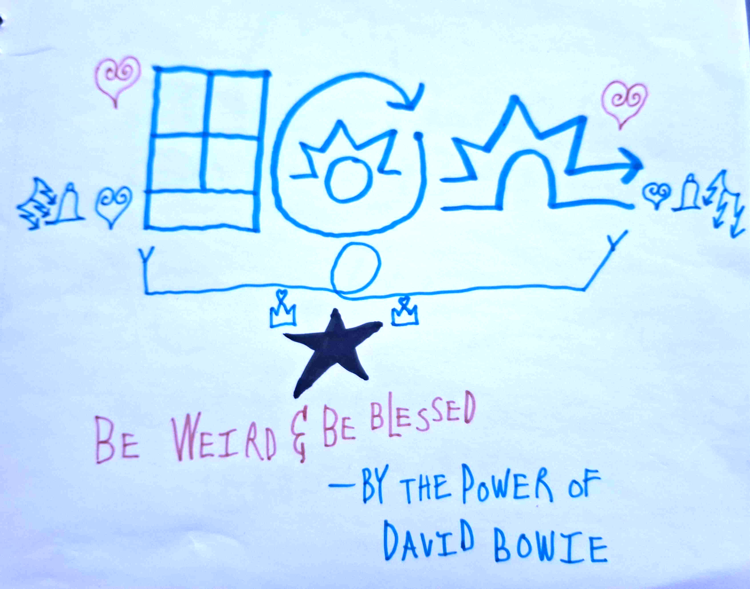
The central message in the above image is a simple phonetic spelling of “weird”: window, year, dawn. It is enclosed by one magical function: the heart character, which bestows a blessing. Three grammatical functions enclose it. The heart character emphasizes the positive connotations of the word it encloses (here “weird”); the bell confirms that the enclosed text should be read phonetically. The storm renders the enclosed text into an imperative verb, thus, “be weird.”
Beneath the “weird” text is the irregular function of champion, marking the message as empowered by the authority of a specific Power: in this case, the divine spirit of David Bowie, here represented by the titular black star of his final album, bracketed by the crown function, used to signify a beloved god or other highly honored spirit.
“Be weird and be blessed by the power of David Bowie” is largely a literal translation here.
The typical finishing silence mark followed by the sealing jar is missing here due to lack of space. This is permissible but not advised unless you specifically want a more open-ended spell. Here, its absence may be interpreted as inviting all viewers to bring their own form of weirdness to the table.
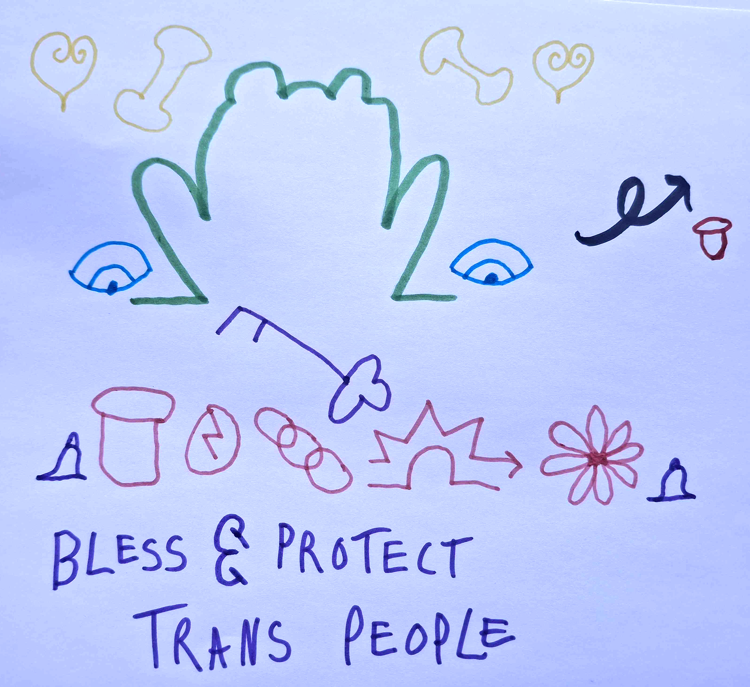
This example uses the key function to employ some poetic license. In the center of the message is the frog character, enclosed by the grammatical function of eye to indicate that it should be read for its deeper meaning. Above, it is enclosed by the magical functions of heart and bone: bless and protect. Afterwards, it features a silence mark and a sealing jar to finish the spell.
Where “bless and protect frog” becomes “bless and protect trans people” is in the meaning made (or unlocked) by the key function. Beneath the key character is a phonetic spelling of “gender.” Thus a literal translation of the message is, “Bless and protect the frogs of gender.” But the indication that “frog” should be read for its deeper meaning rather than its literal meaning tells us to interpret frog as “one who crosses borders or boundaries.” Thus, the “frogs of gender” are transgender people. While “bless and protect trans people” is not a literal translation here, it is a correct one.
More examples coming soon! Go back to the main page?